Polymetallic nodules in the Clarion-Clipperton Zone in the Pacific Ocean. Source: ROV KIEL 6000, GEOMAR
In 2024, a study published in Nature Geoscience garnered significant attention from both the scientific community and international media.
Evidence of dark oxygen production at the abyssal seafloor was published in Nature Geoscience by an international team of researchers led by Dr. Andrew Sweetman at The Scottish Association for Marine Science. Their research was based on several cruises in the Pacific Ocean’s Clarion-Clipperton Zone (CCZ).
In their research communiqué, the team proposed that polymetallic nodules on the seafloor may create currents strong enough to produce oxygen by splitting water molecules through a process known as electrolysis. The term “dark oxygen” refers to the production of oxygen in an environment where photosynthesis is not possible (the abyssal sea floor is pitch black).
The process would require a previously unrecognized energy source and could according to the authors have far-reaching implications for ocean chemistry and even theories about life on Earth and other planets.
However, the claim has remained unreplicated and widely debated.
At Seabed Minerals 2026 in Bergen (24–26 March), Environmental Scientist Patrick Downes of The Metals Company will present a published critique evaluating the original study.
The review highlights three main concerns: inconsistency with comparable benthic chamber studies, lack of a viable energy source to drive electrolysis, and evidence from control experiments suggesting the oxygen signal may originate from the measurement system itself rather than from the nodules.
Multiple independent studies from nodule-bearing regions in the Pacific report only oxygen consumption, consistent with global abyssal averages. In addition, the voltages measured across nodule surfaces fall well below what is required to split water under laboratory conditions. Furthermore, hydrogen, a necessary by-product of electrolysis, was not reported.
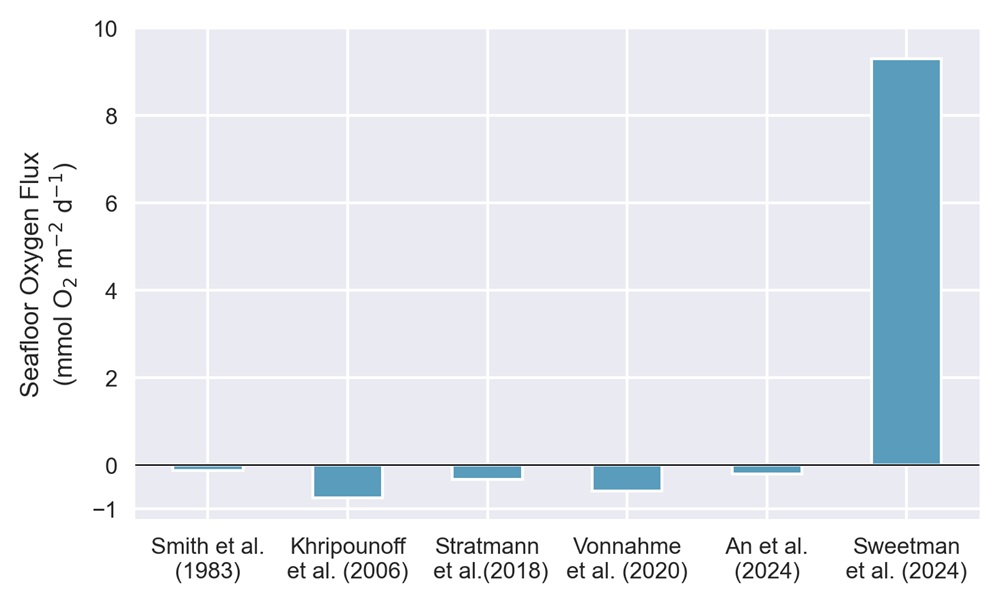
The presentation will examine whether the reported dark oxygen signal reflects a genuine geochemical process or an experimental artefact — a question with significant implications for deep-sea science and seabed mineral research.
Program and registration details are available on the conference website.