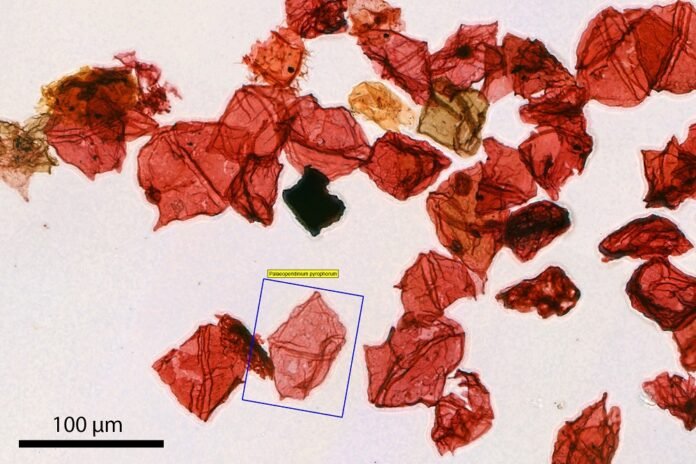
Detail of a digital palynology slide with the marine microplankton Palaeoperidinium pyrophorum. Source: Robert Williams, Norwegian Offshore Directorate
Microfossils play a critical role in subsurface interpretation.
Because different species lived at different times in Earth’s history, they help geoscientists determine the age of sedimentary rocks, correlate wells and reconstruct ancient depositional environments. This information supports everything from regional geological studies to exploration and field development.
Recent digitization efforts have made vast quantities of palynological data available for analysis, creating new opportunities for artificial intelligence.
geo365.no: Nature’s microplastics
At the Dig X Subsurface 2026 conference in Lillestrøm, David Wade, Researcher, Geoscience Data & Analytics at Equinor, will present a study examining whether modern vision-language models can match the performance of experienced palynologists.
The research builds on Equinor’s work with SCAMPI, a machine-learning tool developed to help identify and classify microfossils from digital palynology slides.
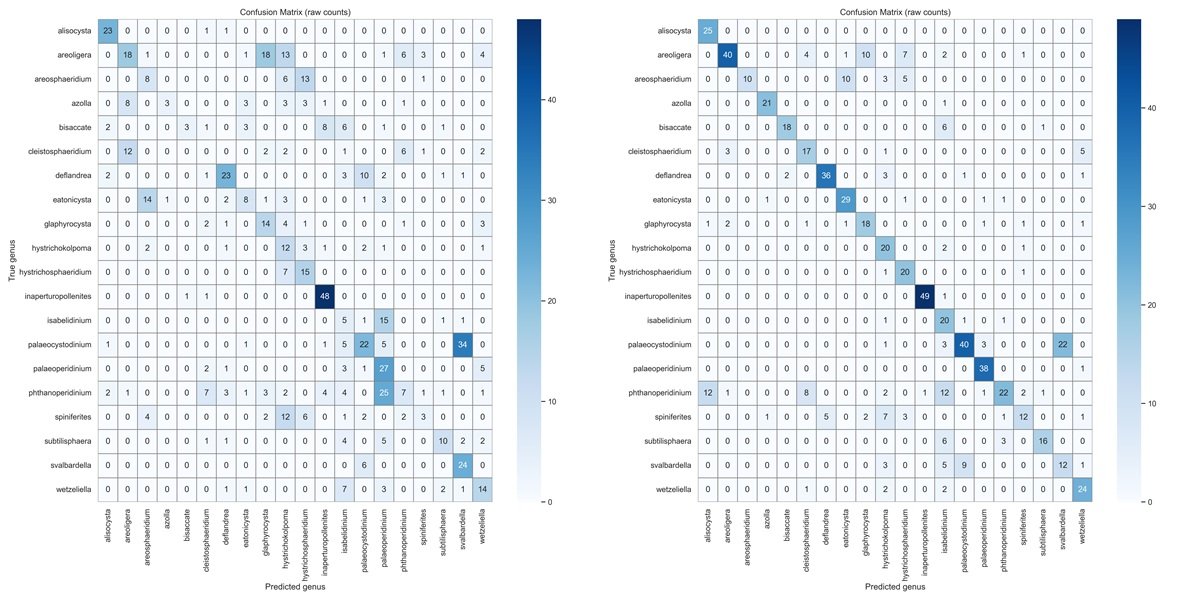
To test the technology, the team used an open dataset containing 697 images representing 20 groups of microfossils from the Norwegian Continental Shelf. They compared several approaches, including the latest vision-language models, specialized computer-vision models and human experts.
The results revealed a clear hierarchy. General-purpose AI models performed better than earlier generations, but still struggled to distinguish between fossil groups that look very similar.
Models trained specifically for palynology performed significantly better than the general-purpose systems. Human experts, however, remained comfortably ahead of both, achieving much higher scores.
According to the authors, the findings highlight the importance of domain-specific AI. While frontier models continue to improve rapidly, specialized models remain both more accurate and more cost-effective for this type of task.
The study clearly suggests that human expertise remains essential. Experienced palynologists were consistently better at recognising small differences between fossil groups than any automated approach tested.
Humans, however, cannot match the speed of automated systems when analysing large digital datasets. According to the authors, the greatest value lies in combining AI with human interpretation. This hybrid approach can rapidly screen and classify large volumes of digital palynology data while leaving the final quality control and interpretation to experts.
Join us in Lillestrøm on December 2-3 to learn how Equinor is testing the limits of AI-powered fossil identification. The presentation is part of Dig X Subsurface 2026, a conference dedicated to digital workflows, data and AI in subsurface geoscience. The program can be found on the conference website.