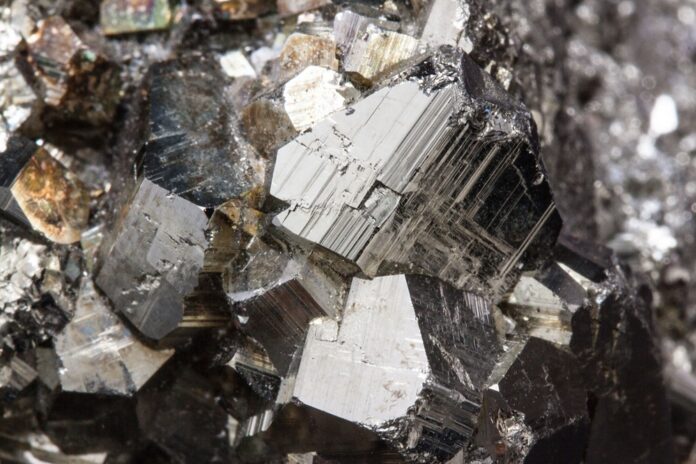
Pyrite, also known as fool’s gold, is the most abundant sulfide mineral in many hydrothermal systems and can host significant amounts of «invisible» gold.
A new study on the Higashi-Aogashima submarine caldera, located about 360 km south of Tokyo, has revealed some of the highest concentrations of gold ever reported in pyrite from a seafloor hydrothermal system.
The concentrations were indeed so high that the authors report some results in weight percent (wt.%) rather than the more commonly used parts per million (ppm). One pyrite sample yielded as much as 1.9 wt.% gold, or about 19,000 ppm.
In terms of economic potential, however, the key metric is the grade of the deposit as a whole rather than the concentration within individual mineral grains. Even so, the findings are noteworthy because the hydrothermal field was already known for exceptionally gold-rich sulfide deposits.
Earlier studies documented bulk-rock gold grades of up to 275 ppm, with an average of 102 ppm, far exceeding the 0.01-43 ppm range typically reported from seafloor massive sulfide deposits worldwide.
Another factor relevant to potential future development is the depth of the deposits. The hydrothermal field lies in water depths of about 700–820 metres, relatively shallow compared with many other seafloor sulfide deposits.
The new findings point to the importance of pyrite as a host for so-called “invisible gold” – gold that cannot be seen under a microscope as discrete grains. Gold and arsenic were consistently more concentrated in pyrite than in the surrounding rock, suggesting that pyrite acts as an efficient sink for both elements during hydrothermal mineralisation.
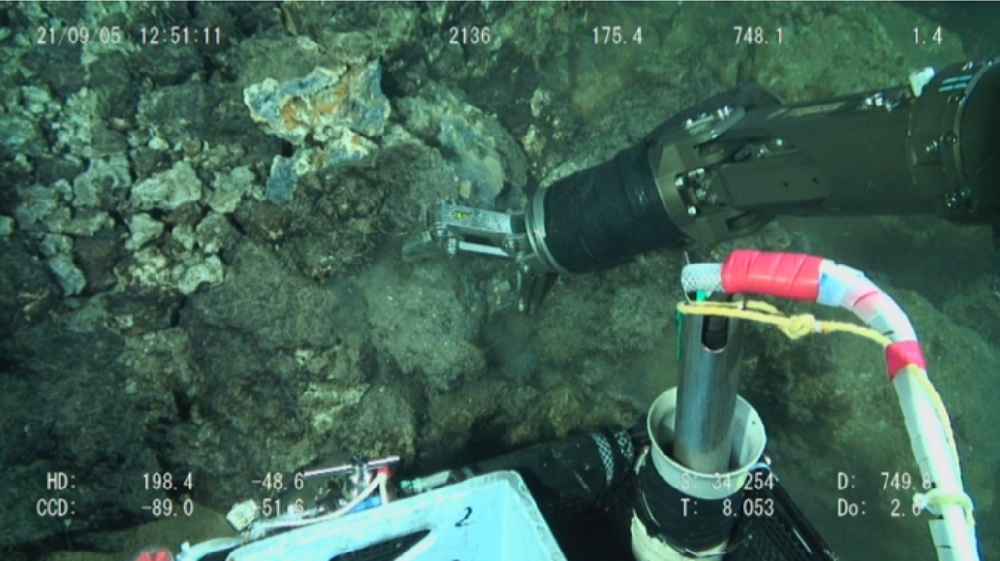
The study is based on samples collected from three hydrothermal sites within the caldera. Sulfide mound samples were recovered in 2021 using the research vessel Shinsei-maru and the ROV Hyper-Dolphin, while a sample from an active chimney was collected at Central Cone Site during a 2022 expedition.
Using Secondary Ion Mass Spectrometry (SIMS), the researchers investigated how the gold is hosted within the mineral. The analyses found no evidence of gold nanoparticles. Instead, the gold appears to be distributed throughout the pyrite crystals and incorporated directly into their crystal structure, explaining its “invisible” character.
The study also provides new insights into the controls on gold enrichment. Geologists have long recognised a relationship between arsenic and gold in pyrite, with arsenic-rich pyrite generally able to host larger amounts of gold. While the Japanese samples partly follow this trend, arsenic alone could not explain the highest gold concentrations.
The most gold-rich pyrites were also enriched in lead and copper. The authors suggest that these elements may help create structural conditions that allow unusually large amounts of gold to become incorporated into pyrite. If confirmed by future work, this would mean that existing models for gold solubility in pyrite may not fully capture the processes operating in submarine hydrothermal systems.
The study demonstrates that a significant proportion of the gold present in the deposits occurs within pyrite rather than as visible gold grains. For exploration geologists, these findings highlight the importance of looking beyond visible gold and examining sulfide-mineral chemistry when assessing the economic potential of hydrothermal ore systems.