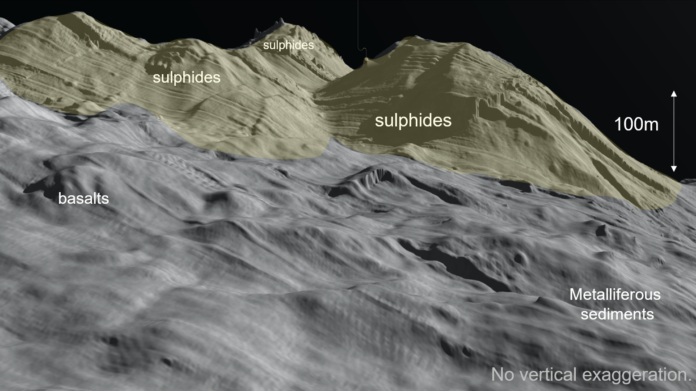
Perspective view of the SMS mounds at Semenov 4 hydrothermal field, located on the Mid-Atlantic Ridge. The mounds represent a large part of the resource estimate, which may exceed 100 million tonnes of sulphides. Illustration: Project ULTRA (Micro-bathymetry courtesy of Xavier Escartin (Odemar cruise))
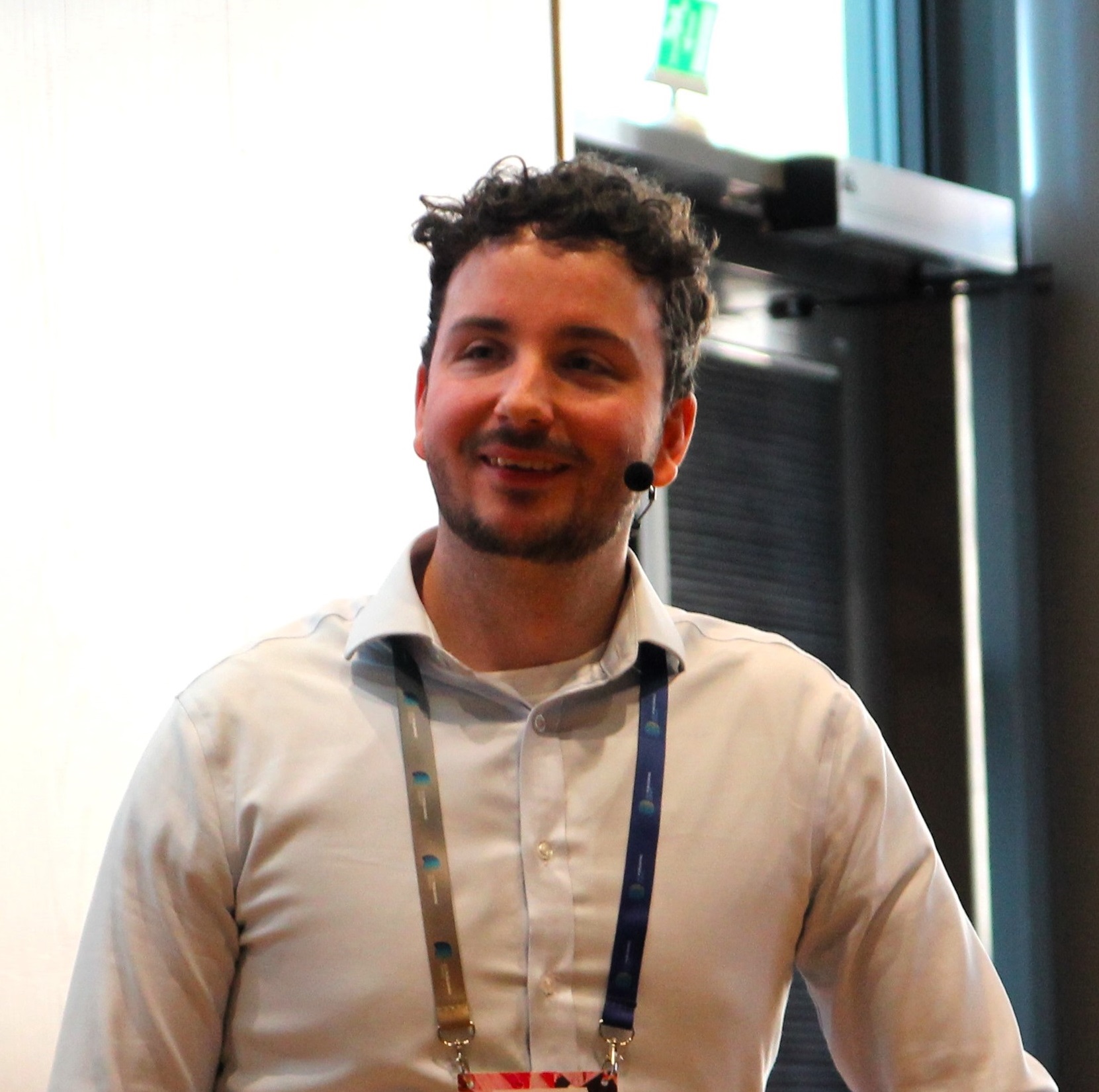
– Semenov may represent the largest massive sulphide deposit in the world, said Christian Bishop, Mineral Commodity Analyst at British Geological Survey (BGS), during the Seabed Minerals 2026 conference in Bergen in March.
The Semenov hydrothermal fields, located at 13°N along the Mid-Atlantic Ridge (at a latitude similar to that of Senegal and Nicaragua), have been the focus area for project ULTRA for several years.
Bishop, until recently a postgraduate researcher at the University of Southampton, was pleased to share a first quantitative assessment of the potential resources at Semenov, which consists of five discrete hydrothermal areas.
The results, preliminary in nature, describe high-, medium- and low-confidence estimates for the seafloor massive sulphide (SMS) deposits as well as the “secondary” deposits metalliferous sediments, weathered rocks and sulphide sands.
In total, these deposits could contain more than 100 million tonnes (Mt) of ore, with grades exceeding 3 wt. % copper. The high-confidence estimate places the metal endowment at about 1.4 Mt of pure copper – a potential world class SMS resource.
The estimates are based on years of mapping and collecting data and physical samples along this part of the Mid-Atlantic Ridge. The project team has been using tools such as high-resolution seafloor mapping, remotely operated vehicles, seafloor drilling, sediment coring, sub-seafloor imaging by seismic reflection and refraction, and sub-seafloor resistivity surveys using controlled source electromagnetics.
Bishop described the calculation method as rather straightforward.
– We looked at geological maps to determine the surface extent of the deposits, and used samples to determine thicknesses, giving us volume estimates.
The samples also provided metal grades in weight percent. Volumes were turned into tonnage using appropriate rock densities, and the final metal endowment (Mt) was simply tonnage multiplied by grade.
The three confidence levels reflect how much is actually observed versus inferred. High-confidence figures rest on ground truthed data, with observed thicknesses and extent. Low-confidence figures include more speculative extensions and thickness.
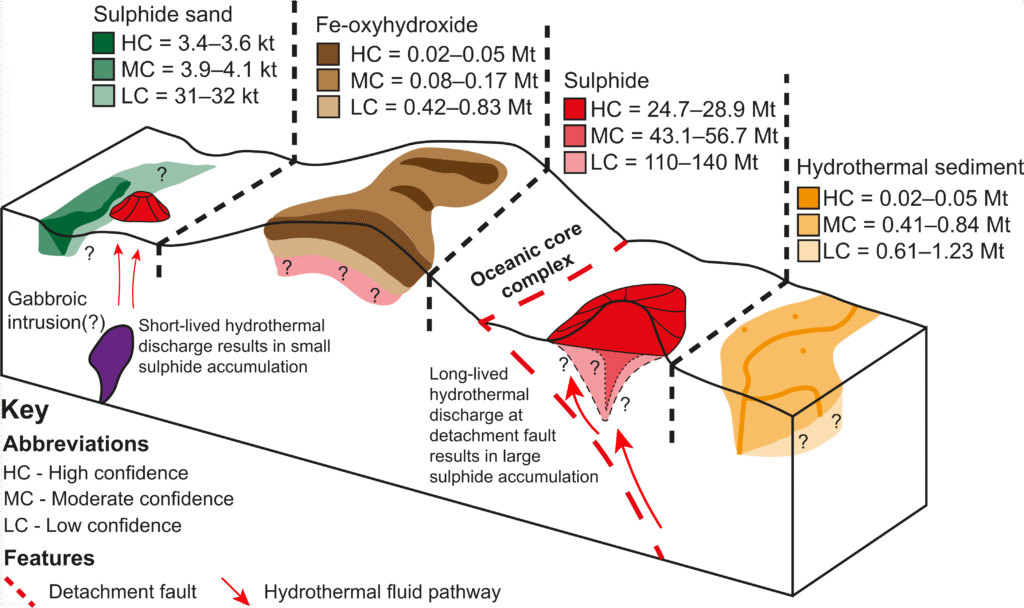
The results show that the massive sulphides dominate the resource estimate in all scenarios, due to having the highest tonnage, while also having high metal grades. Interestingly, the sulphide sands are exceptionally rich in copper, with 23.6 wt. %, compared to 3.3 wt % for the massive sulphides.
– These sands consist of unconsolidated material which are almost entirely made up of the copper mineral bornite, Bishop pointed out.
So far, Bishop’s calculations show that Semenov compares well with other known large SMS deposits, such as Yuhuang-1 on the Southwest Indian Ridge and the TAG field farther south on the Mid-Atlantic Ridge. It also shines when compared with terrestrial volcanic-hosted massive sulphides (VMS), which sport a median tonnage of 3 Mt.
Slow cooking gives better results
What makes an SMS deposit exceptional in size? For the project ULTRA team, the answer is clear.
It is well known that these types of deposits form along the world’s mid-ocean ridges.
Where the oceanic plates separate, boiling, mineral-laden fluids rise from the depths toward the seafloor. When the hot water meets cold seawater, the minerals are dumped at or beneath the seafloor, building chimneys and mounds enriched in a wide range of metals including copper, zinc, cobalt, gold and silver.
However, not all ridges behave in the same manner. Slow- and ultraslow-spreading ridges provide better habitats for the ore-forming processes. They are often dominated by tectonic processes (as opposed to magmatic) and may feature oceanic core complexes (OCCs).
OCCs form where magma supply is limited and spreading is asymmetric, resulting in long, low-angle detachment faults that exhume upper mantle rocks.
These faults can be active for hundreds of thousands of years, maintain high temperatures and open fluid pathways, enabling continuous hydrothermal circulation. This “slow cooking” allows far more minerals to accumulate in one place, leading to higher tonnage.
Semenov sits in exactly such a setting on a slow-spreading section of the Mid-Atlantic Ridge, with limited magma supply, deep-rooted faults and one confirmed OCC.

Guided by sediments
There is valuable material – and information – to be found in the sediments nearby active and inactive SMS deposits.
During last year’s Deep Sea Minerals conference in Bergen, project ULTRA member Acer Figueroa highlighted how metalliferous sediments around SMS deposits can serve as effective exploration vectors.
Sediment cores influenced by hydrothermal activity carry geochemical signatures of nearby mineralization. Metal enrichments (such as copper, zinc and iron) can be detected up to 1 km from recently inactive mounds and at least 200 metres from mineralized fault zones.
By integrating sediment coring with geochemical scanning, explorers can cover wider areas efficiently and vector more quickly toward hidden or buried sulphide deposits — a practical addition to traditional mapping and drilling methods.
Arctic potential
The results from Semenov thus far provide a clear blueprint for SMS explorers elsewhere. Bishop specifically pointed to the ultraslow-spreading Arctic ridges in Norwegian waters – the Mohn’s and Knipovich ridges – which share the same favorable geological conditions.
As of yet, the discoveries along the Arctic ridges have not yielded any Semenov-scale deposits. For instance, according to estimates by the Norwegian Offshore Directorate, Mohn’s Treasure on the Mohn’s Ridge could hold a bit more than 2 Mt.
However, he pointed out that the ridges remain highly prospective for undiscovered OCCs that could in turn host significant SMS mineralization. The lack of large discoveries thus far may simply be a result of the ridges being underexplored.
The ULTRA team’s work also shows the value of “secondary” deposits. While these materials — metalliferous sediments, weathered rocks and high-grade sulfide sands — are smaller in volume, their position on the seafloor and elevated metal grades can contribute economically interesting amounts of ore and serve as useful exploration guides.
While Norway’s first licensing round has been delayed for at least four years, mapping efforts are still ongoing in 2026 and Norway is well-positioned to leverage these insights. Several Norwegian participants, including the University of Bergen, Equinor, and Green Minerals, are part of the project, alongside the National Oceanography Centre, the British Geological Survey, the universities of Cardiff, Southampton, Leeds, and the Memorial University (Canada), as well as GEOMAR (Germany).