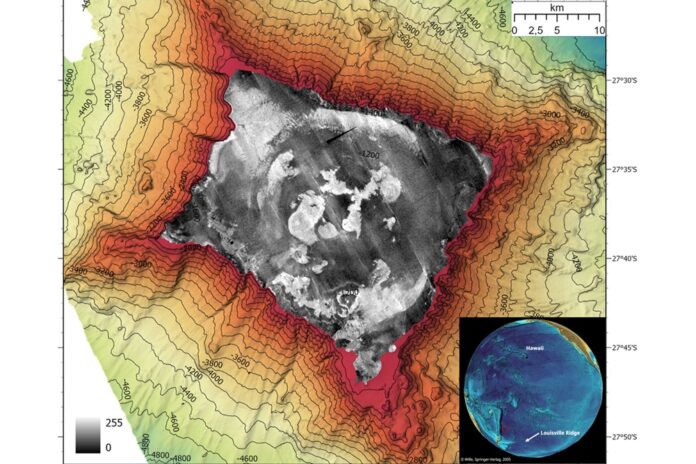
Backscatter intensity data of the summit area of Seamount 420. High backscatter values (bright areas) indicate hard rock outcrops with crust coverage. Source: BGR
There are estimated to be several tens of thousands of seamounts present in the global oceans, with some predictions exceeding 100,000. Since the world’s oceans are yet to be fully mapped, the exact number remains unknown.
From a resource perspective, these underwater mountains have long attracted interest due to conditions that favour the formation of ferromanganese crusts enriched in critical metals such as cobalt, nickel, and rare earth elements including yttrium (REY).
In the summer of 2025, the German Federal Institute for Geosciences and Natural Resources (BGR) conducted a research cruise to the northern part of the Louisville Ridge in the southwest Pacific Ocean east of New Zealand.
The expedition mapped 14 seamounts over a distance of approximately 650 km using vessel-mounted and station-based instruments. It focused on assessing the occurrence and economic potential of ferromanganese crusts, alongside benthic species distribution and localized hydrographic features.
The Louisville Ridge is the second longest seamount chain worldwide, stretching over 4,500 kilometres and hosting dozens of seamounts aged between 34 and 75 million years.
Many form large flat-topped summit plateaus (Guyot-type), while others are sharper with a small top (Burton-type).
Thomas Kuhn, Research Associate and Project Manager at BGR, presented some preliminary results at the Seabed Minerals 2026 conference in Bergen.
“The topography is rough,” Kuhn noted, referring especially to the seamount slopes, which are prone to erosion, slumping and mass wasting due to volcanic origins and volcaniclastic material. These steep gullies, ridges and exposed volcanic rocks limit the formation of continuous thick crusts on the slopes and may complicate future mining operations.
In contrast, the summit areas of large seamounts offer relatively stable, flatter conditions more favourable for long-term crust growth.
A key control on crust prospectivity is sediment cover, which is strongly influenced by factors such as the size of the summit plateau and local near-bottom currents. On the investigated seamounts, sediment coverage ranged from nearly 0 % on the small Burton Seamount (summit area ~25 km²) to about 60 % on the much larger Seamount 420 (summit area ~600 km²).
Preliminary resource calculations based on collected cruise data illustrate the potential scale.
On Seamount 420, approximately 260 km² of the summit is sediment-free hard substrate covered by ferromanganese crusts. Assuming an average crust thickness of 3 cm, this yields roughly 12.6 million tonnes of crust (ore) material, Kuhn showed.
At grades of approximately 0.50 % cobalt and 0.20 % REY, this single seamount could host around 63,000 tonnes of cobalt and 25,000 tonnes of REY. For context, global cobalt production in 2024 was 270,000 tonnes.
Compared with other studied seamounts along the ridge (including the Louisville and Burton seamounts), Seamount 420 stands out due to its large summit plateau and relatively low sediment coverage. In total, BGR has calculated 15 seamount features along the Louisville Ridge could contain 252 million tonnes of crust material.
Kuhn pointed out that the Louisville Ridge appears more prospective than many other seamount regions in terms of cobalt and REY content (including heavy rare earth elements). However, strong erosion on the slopes and variable sediment cover on the plateaus, influenced by current regimes and local bathymetry, remain important challenges.
Ferromanganese crusts grow extremely slowly (1–5 mm per million years) on hard substrates where oxygen-rich bottom currents rise along the slopes and interact with metal ions in seawater, typically at depths of 800–2,500 m.
While seamount summits with low slopes and flat topography could represent attractive targets for future exploration and exploitation, any development would need to address both the technical difficulties of selective harvesting on irregular terrain and the broader environmental considerations.